Triblock Copolymer Vesicle Morphogenesis
May 6, 2024
·
1 min read
Scientific question
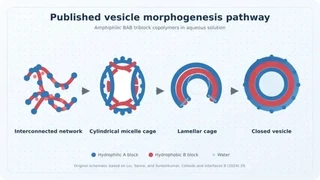
How do initially dispersed amphiphilic BAB triblock copolymers reorganize into a closed vesicle, and what molecular changes accompany each transition along the pathway?
Approach
We used coarse-grained molecular dynamics with explicit aqueous solvent and MARTINI-based interactions to follow self-assembly from randomly distributed polymers. The analysis connected aggregate morphology with aggregation number, hydrophobic contact with solvent, and polymer end-to-end distance distributions.
Main published findings
- Vesiculation proceeds through an interconnected aggregate network, a cage of cylindrical micelles, and a lamellar cage before the membrane closes.
- The cage-to-vesicle transition occurs at essentially constant aggregation number while nearly eliminating contact between the hydrophobic B blocks and the solvent.
- Folded chain conformations are common both for isolated polymers and for polymers within the vesicle. The end-to-end distance distribution becomes broader inside the vesicular bilayer.
- Increasing B-block hydrophobicity shortens the vesiculation time without qualitatively changing the self-assembly pathway.
Why it matters
The study provides a molecular-level picture of how hydrophobic interactions, chain conformations, and collective packing changes produce a closed polymer vesicle.
Authors
Mohammad Sadegh Samie
(he/him)
PhD Candidate in Biomedical and Chemical Engineering
I am a PhD candidate in Biomedical and Chemical Engineering at Syracuse University,
advised by Prof. Radhakrishna Sureshkumar and co-advised by Prof. James Henderson.
My research uses coarse-grained molecular dynamics to study polymer and surfactant
self-assembly, with a focus on amphiphilic copolymer systems, micelles, vesicles,
and the molecular mechanisms that drive morphology evolution.